INTRODUCTION
When renovating a bathroom or installing a new shower surround, selecting the proper wall substrate is one of the most critical decisions you will make. A common misconception among homeowners and novice builders is that moisture-resistant wallboard, commonly known as green board, is completely waterproof. Relying on green board as a sole line of defense against continuous water exposure often leads to catastrophic structural failures, mold growth, and expensive tear-outs. Understanding the distinction between water resistance and waterproofing, along with strict adherence to manufacturer guidelines, is essential for a long-lasting installation.
THE DIFFERENCE BETWEEN WATER-RESISTANT AND WATERPROOF
Green board drywall is designed with a water-resistant paper facing and a treated core that helps retard moisture absorption in high-humidity areas, such as residential powder rooms or kitchen walls. However, water resistance does not mean waterproof.
When exposed to direct or standing water, green board absorbs liquid over time. Water saturation breaks down the gypsum core, causing the material to swell, lose structural integrity, and crumble. In severe cases, the board completely disintegrates behind shower panels, acrylic tub surrounds, or tiled walls. True waterproofing requires an continuous, impermeable barrier or a zero-absorption substrate specifically manufactured to prevent liquid water migration into the wall cavity.
CONSEQUENCES OF MOISTURE PENETRATION
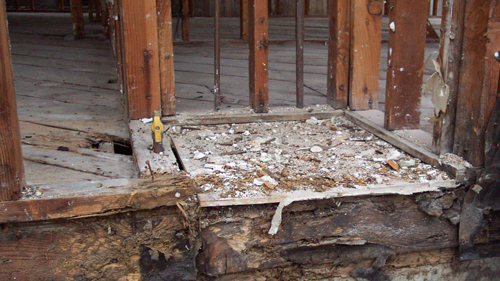
When water migrates behind a tub or shower surround, it creates an ideal environment for wood rot, structural framing damage, and mold proliferation. Because this degradation occurs hidden behind wall panels or tiles, severe damage often progresses unnoticed for months or years. By the time soft spots, tile movement, or visible crumbling appear near the base of the wall, the underlying studs and subfloor may already require extensive remediation.
MANUFACTURER SPECIFICATION AND COMPONENT COMPATIBILITY
Avoiding water damage requires strict adherence to manufacturer installation instructions and building codes. Manufacturers design substrates, adhesives, joint compounds, and sealants to function as unified systems. Using incompatible materials can undermine the entire assembly and void manufacturer warranties.
For example, using standard water-soluble joint compound to tape or fill seams behind a wet-area panel can result in failure, even if the board itself is water-resistant. If water penetrates the outer layer, standard joint compound re-hydrates and dissolves. Always verify that all fasteners, tapes, adhesives, and finishing compounds match the substrate manufacturer's specifications for wet-area applications.
BEST PRACTICES FOR SUBSTRATE PREPARATION
Proper surface preparation is mandatory prior to installing tub panels or tile surrounds. Seams, corners, and fastener heads must be properly finished and smoothed to create a flat, stable surface.
While some installers apply paint or primers over substrate edges before attaching panels, caution is necessary. Applying adhesive over improperly bonded paint can result in bond failure if the paint peels away from the board. If paint or primer is used to seal exposed gypsum edges, ensure it is fully compatible with the construction adhesive used to secure the wall panels.
CONCLUSION
Green board has its place in building construction, but it is not a universal solution for direct wet areas. Long-term performance relies on choosing the correct material for the application, understanding product limitations, and following manufacturer specs. By treating water resistance and waterproofing as two entirely different standards, you protect your property from hidden decay and structural failure.
THREE KEY TIPS
Always distinguish between moisture-resistant substrates and complete waterproofing systems before installing wall panels or tile in direct wet locations.
Strictly adhere to manufacturer instructions regarding compatible fasteners, joint tapes, adhesives, and sealants to prevent voiding product warranties.
Never rely on water-soluble organic joint compounds in wet zones; use approved chemical-setting compounds, cementitious mortars, or waterproofing membranes as required by code.
BONUS QUESTIONS AND ANSWERS
QUESTION: Can green board be used directly behind tile in a shower enclosure according to the residential building code?
ANSWER: While green board is widely available, understanding where building codes permit its use is essential for preventing structural failure. Under the International Residential Code (IRC Section R702.3.8), standard water-resistant gypsum board (green board) is prohibited as a direct backing substrate for tile in wet locations like shower stalls or tub compartments unless protected by an approved continuous waterproof membrane or unless cementitious backer units (CBU) meeting ASTM standards are used. Tile and grout are inherently porous, allowing moisture to migrate through to the substrate. Under constant exposure, paper-faced green board softens, loses its structural bond with the tile, and decays.
QUESTION: Why does regular drywall joint compound fail when exposed to moisture behind tub surrounds or tile?
ANSWER: Beyond selecting the right substrate board, builders and homeowners must also consider the materials used to finish the joints. Ready-mixed joint compound (pre-mixed mud) is vinyl- or starch-based and cures strictly through evaporation. When exposed to humidity or water intrusion, it re-hydrates, turns soft, and loses its adhesive bond, leading to tile detachment or delamination of acrylic surrounds. The IRC and Tile Council of North America (TCNA) standards require water-resistant setting-type compounds (powdered chemical-setting compounds) or cementitious mortars in high-moisture assembly applications to maintain structural integrity.
QUESTION: What is the structural purpose of leaving a gap at the bottom of backer boards above a tub or shower pan flange?
ANSWER: Proper physical installation details at material transitions are just as critical as choosing the correct water-resistant products. Industry standards from the TCNA and IRC wall cladding guidelines require a 1/8-inch to 1/4-inch gap between the bottom edge of the wall substrate board and the lip of the shower pan or bathtub flange. Leaving this gap prevents capillary action (wicking), where standing water on the lip of the tub or shower base travels upward into the core of the backing board. This gap is subsequently sealed with a flexible, 100% silicone sealant rather than rigid mortar or joint compound to allow for natural structural expansion and contraction.