Building a durable, structurally sound concrete pond requires meticulous preparation, the right materials, and a strong understanding of fluid mechanics. The coping or decking that surrounds the pond serves as both a structural cap and an aesthetic border. Properly forming, reinforcing, and pouring this section is critical to the longevity of your outdoor water feature.
STRUCTURAL DECKING AND REINFORCEMENT
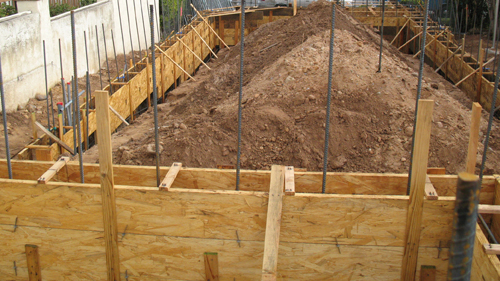
The circular deck of a pond should be poured to a minimum thickness of 4 to 4.5 inches to ensure adequate structural integrity. Steel rebar must be installed within the forms to provide essential tensile strength and prevent structural cracking over time. When establishing the final grade, always use a level and a straight edge across the forms. For wider concrete decks, industry best practices dictate sloping the concrete slightly away from the water, typically at a grade of 1/4 inch per foot, to prevent standing water. However, for a narrow pond coping measuring roughly 18 to 20 inches wide, a perfectly flat, level finish is generally acceptable, as water can naturally drain off the short edges without pooling.
FORM PREPARATION AND RELEASE AGENTS
Before pouring, all wooden forms must be thoroughly coated with a form release agent. An accessible option is heavy cooking oil, applied generously with a paint roller and brush. Failing to apply sufficient form release will cause the curing concrete to adhere strongly to the wood. When the forms are eventually stripped, this adhesion pulls chunks of concrete away from the structure, resulting in surface voids, spalling, or severe honeycombing near the upper rim. A liberal, even coating ensures a smooth release and a pristine, professional finish without the need for extensive patching.
SELECTING THE RIGHT CONCRETE MIX AND PUMPING
Navigating the logistics of concrete delivery often requires a concrete pump, especially if the pond site is located in a backyard or far from street access. Keep in mind that pumping distances exceeding 200 feet may incur additional charges from local pump operators. When ordering from a ready-mix concrete supplier, specify that the concrete is for a water feature. Plant operators frequently recommend ordering a fiber-reinforced concrete mix. The addition of microscopic fiberglass strands provides a secondary matrix of internal support. This works in tandem with the primary steel rebar grid to drastically reduce plastic shrinkage cracks as the concrete cures.
MANAGING SLUMP AND CONSOLIDATION
The water-to-cement ratio, which dictates the slump or wetness of the mix, is crucial for a successful pour. If the concrete is too wet, it acts as a highly fluid mass. The hydraulic pressure of a high-slump mix can cause the concrete to ooze beneath the lower forms and overflow into the bottom of the pond, inadvertently raising the floor elevation and wasting material.
Conversely, a mix that is too dry becomes incredibly difficult to pump, place, and finish. Communicating your specific workability needs to the batch plant ensures an appropriate slump. Furthermore, while a mechanical concrete vibrator is standard for removing air voids in deep structural walls, a highly workable pea gravel pump mix in shallow 4-inch deck forms often consolidates sufficiently on its own without the need for heavy vibration.
THREE ESSENTIAL CONSTRUCTION TIPS FOR POND POURS
APPLY A HEAVY COAT OF FORM RELEASE AGENT: Thoroughly saturate your wooden forms with a release agent like oil. Dry wood will wick moisture out of the wet concrete and bond to it, causing destructive spalling and voiding when you attempt to strip the forms.
ORDER A FIBER-REINFORCED PEA GRAVEL MIX: Requesting fiberglass reinforcement in your ready-mix concrete provides a vital secondary defense against shrinkage cracks, while a smaller aggregate like pea gravel ensures the mix can flow smoothly through pump hoses and tight forms.
STRICTLY CONTROL THE CONCRETE SLUMP: Do not allow the delivery driver to add excess water to the mix. A concrete mix that is too wet creates high hydrostatic pressure, causing the material to blow out from under your formwork and flood the bottom of the pond excavation.
FREQUENTLY ASKED QUESTIONS
While achieving a smooth deck finish is vital for aesthetics, protecting the structural integrity of the entire water feature requires thinking beyond just the concrete deck pour.
1. Should I pour the pond floor and walls at the same time, or do them separately?
For a completely watertight concrete pond, a continuous (monolithic) pour is always the best approach. Pouring the floor and walls together prevents "cold joints" the seams where fresh, wet concrete meets already-cured concrete. Cold joints are inherently weak points that are notorious for leaking under water pressure. If a single pour isn't possible due to the size or complexity of the formwork, you must install a specialized waterstop (such as a swelling bentonite clay strip) securely in the center of the floor joint before pouring the walls to ensure the gap seals permanently.
2. What is the best way to build forms for a curved pond design?
Standard dimensional lumber won't work for sweeping, organic pond curves. Instead, use flexible formwork materials like 1/4-inch hardboard (Masonite), bender board, or kerfed plywood (plywood with evenly spaced vertical relief cuts that allow it to bend). Because these flexible materials are much thinner and structurally weaker than standard lumber, they require much tighter staking typically driving stakes every 12 to 16 inches. You will also need strong horizontal supports (walers) wrapping the outside to prevent the thin material from bowing under the weight of the concrete.
3. How do I prevent the forms from blowing out at the bottom?
Wet concrete acts like a heavy liquid, creating intense hydrostatic pressure that is concentrated at the very bottom of your forms. To prevent a blowout, drive heavy wooden or steel stakes deeply into firm, undisturbed soil along the base. Reinforce the outside of the forms by adding diagonal braces (kickers) running from the upper portions of the stakes down to a secured block on the ground. If you are building an in-ground pond, you can often use the excavated earth wall as your outer form to completely eliminate the risk of an outer blowout, provided the soil is heavily compacted and stable.