POURING AND FINISHING A CONCRETE POND
The pouring and finishing phase of a concrete pond is where careful planning meets physical execution. Successfully shaping a structural water feature requires precise timing, proper material mixtures, and a thorough understanding of how concrete behaves as it cures.
PROTECTING SURFACES AND MANAGING THE POUR
When utilizing a concrete pump for a pond project, the mix is often formulated to flow easily, which can sometimes result in a wetter consistency than anticipated. For water features, utilizing a concrete mix reinforced with fiberglass additives is highly recommended to help minimize early shrinkage cracks. Before the pour begins, it is vital to protect all adjacent structures. Using physical barriers, such as scrap plywood, will shield nearby block walls or masonry from colored concrete splatter, which is incredibly difficult to remove once it begins to harden.
TIMING THE FORM REMOVAL
One of the most critical and physically demanding aspects of concrete construction is knowing exactly when to strip the forming boards. As the concrete begins to set up and lose its excess moisture, you must start the stripping process. Waiting too long will leave you with a rigid, unworkable surface, making it impossible to fill in voids or correct honeycombing. Timing is heavily dictated by the weather; on hot days, the concrete will accelerate its curing process and trap humidity inside the work area, drastically shrinking your window of opportunity to remove the forms and patch the walls while the material is still green and pliable.
FINISHING TECHNIQUES FOR POND WALLS
Once the forms are stripped and the concrete is exposed, the surface finishing must begin immediately. A sponge float, specifically a plaster color coat float, is an excellent tool for this stage. It allows you to effectively rub out imperfections, fill in minor air pockets, and bring a uniform texture to the vertical surfaces. After the rough areas are smoothed and filled with the sponge float, you can follow up with a steel trowel to compress the surface and achieve a tight, professional finish.
THREE KEY TIPS FOR CONCRETE FORMING AND POURING
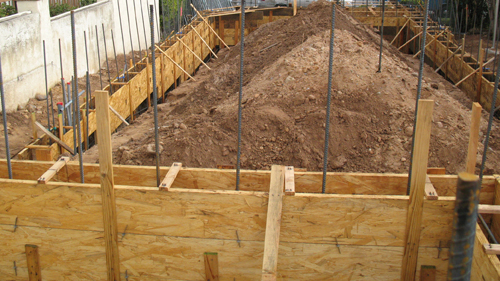
APPLY FORM RELEASE AGENT: You must oil all interior form boards before the pour. Failing to apply a proper form release agent will cause the drying concrete to bond to the wood, resulting in large chunks of your pond wall tearing away when you attempt to remove the boards.
ENGINEER FORMS FOR EASY DISASSEMBLY: Build your formwork backward, designing it strictly with the removal process in mind. If your bracing is too complex or difficult to dismantle, the concrete will fully harden before you can strip the forms, leaving you unable to perform necessary surface patching.
LEVEL AND FLATTEN EARLY: As soon as the concrete is placed, begin leveling and flattening the wet material immediately. Establishing your final grade early ensures you are not fighting the concrete as the chemical hydration process accelerates.
ADVANCED STRUCTURAL INSIGHTS FOR WATER FEATURES
To further ensure the success and longevity of your concrete project, consider these advanced structural and code-compliant principles.
WHY IS STEEL REINFORCEMENT REQUIRED IN ADDITION TO FIBERGLASS ADDITIVES?
While fiberglass additives help control plastic shrinkage cracking during the initial setting phase, they do not replace structural steel reinforcement. According to standard structural engineering practices and building codes (such as ACI 318), steel rebar is necessary to handle the tensile stresses caused by soil pressure, water weight, and temperature fluctuations, ensuring the pond walls maintain their structural integrity over time and do not succumb to structural failure.
HOW DO YOU PREVENT STANDARD CONCRETE FROM LEAKING WATER?
Standard concrete is naturally porous and will not hold water reliably without proper treatment. To prevent hydrostatic leaks, established building practices dictate applying a dedicated waterproofing surface membrane or adding crystalline waterproofing admixtures directly to the concrete batch. These methods block the capillary tracts within the concrete matrix, sealing the structure against continuous water exposure.
WHAT IS THE PROPER CURING METHOD FOR A NEWLY POURED WATER FEATURE?
Concrete must cure slowly to reach its maximum structural design strength. In high heat, the rapid loss of moisture can cause severe surface cracking and compromise the concrete's durability. Best practices dictate implementing a wet cure method for at least seven days, keeping the surface continuously damp to allow the chemical hydration process to fully harden the concrete before exposing it to heavy loads or filling the pond with water.