How To Assess And Manage Water Leaks Behind Your Refrigerator
Discovering water pooling underneath or behind a refrigerator can be an alarming experience for any property owner. Often, the visible water on the floor is just a fraction of the actual problem. When a leak occurs inside a wall cavity or behind kitchen cabinetry, the resulting moisture can compromise building materials long before the issue is noticed. Successfully addressing this type of water damage requires careful inspection, an understanding of how building materials react to moisture, and methodical exploratory demolition to locate the source without causing further harm to the property.
Identifying Hidden Water Damage On Walls
Water takes the path of least resistance, frequently traveling down wall framing and pooling behind drywall before making its way onto the finished floor. One of the earliest visual indicators of a hidden leak is the deterioration of interior finishes. When drywall becomes saturated, the moisture breaks the bond between the paper facing of the gypsum board and the applied texture or paint. This results in visible bubbling, blistering, or wrinkling on the wall surface. Because standard joint compound and latex paint rely on a dry substrate for adhesion, they will easily peel away when wet. If you notice these wrinkles appearing near an appliance, the leak has likely been active for at least twelve to twenty-four hours.
Executing Safe Exploratory Demolition
Once a leak is suspected, gaining access to the wall cavity is necessary to find the source. However, aggressive demolition is a common and costly mistake. Plunging a reciprocating saw or a drywall saw blindly into a wall cavity poses a severe safety hazard. Residential interior walls frequently conceal electrical wiring, plumbing supply lines, and HVAC ductwork. Instead of cutting, the initial assessment should begin with small, controlled impacts using a hand tool like a hammer to breach the compromised drywall. By creating a modest inspection hole, you can safely look behind the wall surface, assess the immediate hazards, and carefully remove the wet gypsum board by hand.
Handling Wet Wall Insulation
Opening the wall cavity will often expose the structural framing and the interior insulation. Fiberglass batt insulation acts like a sponge, absorbing and holding water against the wood framing and the backside of the drywall. To properly inspect the plumbing lines and allow the structural framing to dry, all saturated insulation must be pulled out of the cavity. While some homeowners attempt to dry and reuse fiberglass insulation if the leak is strictly clean water, industry best practices typically recommend replacing wet insulation. Wet fiberglass compresses, losing its thermal resistance, and can become a breeding ground for mold if not dried rapidly and completely.
Three Essential Construction Tips For Leak Assessment
Tip 1: Always verify the source before assuming the appliance is at fault. While refrigerator ice maker lines are frequent culprits, water pooling behind the unit could easily be a localized plumbing failure, a leaking valve, or water traveling from a completely different area of the house.
Tip 2: Avoid deep cuts during exploratory demolition. Never use a power saw or aggressively thrust a hand saw into a wall when searching for a leak. Use light taps to break away the saturated drywall, protecting the hidden electrical cables and plumbing pipes inside the cavity.
Tip 3: Remove moisture-holding materials immediately. Saturated drywall loses its structural rigidity, and wet insulation traps water against wood studs. Clearing these materials out of the wall cavity is essential for a visual inspection and for stopping the progression of moisture damage.
Advanced Considerations For Water Damage Repair
To expand on the process of water damage restoration, here are a few advanced considerations that property owners should keep in mind when dealing with plumbing failures.
How Does Moisture Affect The Structural Integrity Of Wood Framing
Wood framing is highly resilient but relies on remaining dry to maintain its load-bearing capacity. The International Residential Code addresses moisture barriers and wood treatments primarily for exterior walls, but interior framing relies entirely on a dry wall cavity. When dimensional lumber reaches a moisture content above twenty percent for a prolonged period, it becomes vulnerable to wood-decay fungi and rot. After a plumbing leak, all exposed wood studs must be thoroughly dried using commercial air movers and dehumidifiers to bring the moisture content back down to an acceptable level before installing new insulation and drywall.
Are There Building Code Requirements For Refrigerator Water Supply Lines
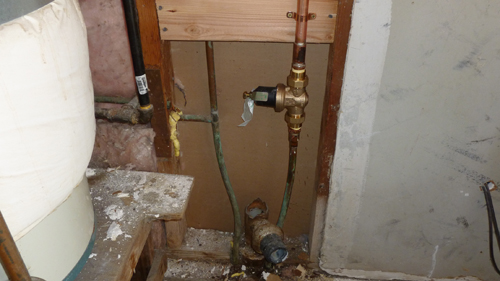
Yes, modern plumbing codes, including the International Plumbing Code, have specific requirements to help mitigate these exact emergencies. The code mandates that the water supply line feeding an appliance like a refrigerator must have an accessible shutoff valve. This ensures that in the event of a line failure, the property owner can quickly terminate the water supply without having to shut off the main water to the entire house. When repairing a leak in this area, always ensure the shutoff valve remains easily accessible behind or adjacent to the appliance.