When tackling a concrete project like a new walkway, patio, or driveway, one of the most common challenges is figuring out exactly how much concrete to order. Guessing can lead to costly delays or wasted material. Fortunately, calculating the correct volume for a rectangular slab is a straightforward process once you know the formula. In this guide, we will walk through the exact steps to determine the cubic feet and cubic yards needed for a standard concrete sidewalk.
THE BASIC CONCRETE VOLUME FORMULA
To find out how much concrete you need, you have to determine the total volume of your form. For a rectangular shape, the formula is length multiplied by width multiplied by depth. However, the trick is making sure all your measurements are in feet. For example, if you are building a sidewalk that is 3 feet wide, 20 feet long, and 4 inches deep, you cannot simply multiply 3 by 20 by 4. You must convert the 4-inch depth into a decimal of a foot.
CONVERTING INCHES TO DECIMALS
To get the correct decimal for your depth, divide the inch measurement by 12.
3 inches divided by 12 equals 0.25
4 inches divided by 12 equals 0.33
5 inches divided by 12 equals 0.416
6 inches divided by 12 equals 0.50
Using our example of a 4-inch deep sidewalk, our math looks like this: 3 feet (width) times 20 feet (length) times 0.33 (depth in feet). This equals 19.8 cubic feet of concrete.
CUBIC FEET VS CUBIC YARDS
If you are buying individual bags of concrete from a home improvement center, knowing the cubic footage is often enough. Many standard bags yield about one cubic foot when mixed, meaning our 19.8 cubic foot project would require roughly 20 bags. However, if you are ordering a delivery from a concrete truck, they sell material by the cubic yard.
There are 27 cubic feet in one cubic yard. To convert your measurement, simply divide your total cubic feet by 27. In our example, 19.8 divided by 27 equals 0.73 cubic yards, which rounds up nicely to three-quarters of a yard.
ACCOUNTING FOR UNEVEN GROUND
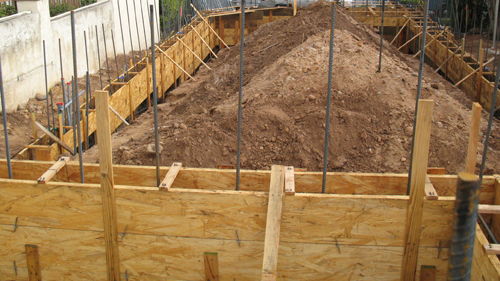
One crucial variable to remember is the condition of your dirt grade. If the ground is not perfectly flat, your depth will fluctuate. A form might be 4 inches deep in one spot but 5 inches deep in a low spot. Because of this, it is always safer to calculate based on the deeper measurement to ensure you have enough material, rather than running out of concrete halfway through the job.
CONCLUSION
Calculating concrete does not have to be intimidating. By converting your depth to a decimal and multiplying it by your length and width, you can easily find your total cubic feet. From there, dividing by 27 gives you your cubic yardage. Double-check your ground level, order a little extra for safety, and your concrete pour will go smoothly.
THREE KEY TIPS FOR ESTIMATING CONCRETE
Always convert your depth measurement from inches to a decimal of a foot before multiplying your dimensions.
Remember the magic number 27: divide your total cubic feet by 27 to find out how many cubic yards you need to order from a concrete delivery truck.
Calculate for the lowest spots in your dirt grade. If the depth varies between 4 and 5 inches, use the 5-inch depth in your formula to ensure you do not run out of material during the pour.